" />
" />
US Carbon Forestry Strategy in Practice
About
McCloud Forest is a mixed conifer timberland estate of approximately 18,900 acres located in Northern California’s Mount Shasta region. The property comprises well stocked stands dominated by true fir, Douglas fir, cedar, and pine, supported by favourable growing conditions, operable terrain, and access to a diversified network of domestic and cross border wood processing facilities. It is a key asset in New Forests’ US Forest Climate Solutions strategy.
As an institutional forestry asset, McCloud Forest reflects the characteristics that have historically underpinned US timberland performance: long investment horizons, biological growth as a source of value creation, and diversification relative to traditional financial assets.
At the time of New Forests’ acquisition, the property exhibited standing timber inventory above regional averages, positioning it as a strong candidate for sustained timber production under active forest management.
In addition to core timber fundamentals, New Forests identified regulated carbon markets as a potential complementary value stream for the asset. These markets impose rigorous requirements around additionality, permanence, monitoring, and verification, making disciplined asset selection and conservative assumptions essential.
Key Initiative
New Forests’ approach in the US evaluates assets under two distinct scenarios:
- A timber‑only case, which reflects conventional sustainable forest management and market‑based timber valuation; and
- A timber‑plus‑carbon case, which explores alternative management pathways compatible with participation in compliance or voluntary carbon markets.
Before acquiring an asset, both scenarios are developed within a single integrated biological and financial modelling environment. New Forests’ investment and data solutions team analyse factors such as timber inventory, calibrated growth and yield projections, harvest scheduling, regulatory constraints, operating costs, and market assumptions are held consistent across scenarios. This structure makes trade-offs explicit, isolating the effects of management choices on timber cash flows, standing inventory, and modelled carbon outcomes, while preventing unverified carbon value from influencing acquisition pricing. Carbon project design and yield forecasting are also evaluated during diligence, while remaining clearly subject to independent verification, regulatory approval, and realized forest performance.
Impact
McCloud Forest illustrates how New Forests integrates timberland management and regulated carbon markets while preserving long‑term flexibility and underwriting discipline.
By anchoring the investment thesis in timber fundamentals, assets remain aligned with how institutional timberland is valued and managed across market cycles. Carbon project participation expands rather than constrains the range of management pathways available over time. Forest managers retain the ability to adapt harvest timing and intensity in response to biological conditions, timber market signals, carbon market developments, and regulatory changes.
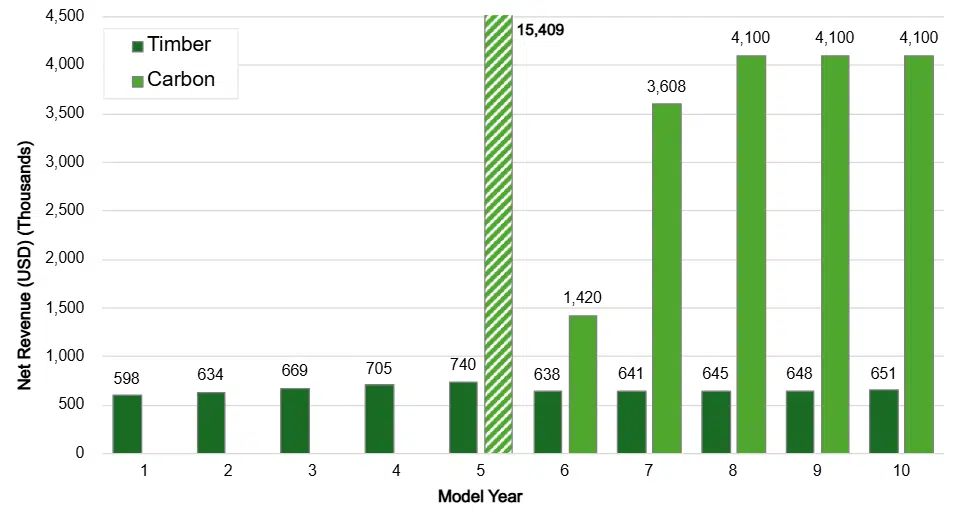
Following acquisition, McCloud Forest entered development of an Improved Forest Management carbon project under California’s compliance framework. Illustrative acquisition stage modelling suggests that carbon revenues may be an important component of net revenue outcomes in a timber‑plus‑carbon scenario, subject to market, regulatory, and verification factors, see Figure Projected Net Revenue by Source under Timber + Carbon Scenario.
Figure – Projected Net Revenue by Source under Timber + Carbon Scenario
More broadly, McCloud Forest illustrates a repeatable process for evaluating US forest investments where timber, carbon, and long‑term stewardship objectives intersect. The case highlights how disciplined underwriting, integrated modelling, and adaptive management can be used to support resilient, diversified outcomes from working forests without relying on speculative assumptions or compromising core timber value.
Figure Source: New Forests’ due diligence and analytics. Illustrative modelling outputs only. Carbon credit issuance is subject to independent third-party verification and regulatory approval, and there can be no assurance that credits will be issued on the anticipated timeline or at all. Publicly available compliance program resources describe the US Forest Projects Protocol framework and the role of independent verification in project eligibility and credit issuance.