" />
" />
Piloting State of Nature Metrics across a Global Natural Capital Portfolio
About
New Forests manages a geographically diverse portfolio of more than 5 million hectares across forestry, agriculture, and conservation landscapes, with a strong focus on delivering long‑term environmental, social, and financial outcomes. As an active manager of landscapes and land‑based assets, we seek to contribute to nature positive outcomes across our portfolio.
Forestry and agriculture, as natural capital investments, play a critical role in halting and reversing nature loss, providing ecosystem services, and supporting the transition to a nature‑based economy. To scale investment into this asset class, we recognise the importance of credible, comparable, and decision‑useful metrics that can demonstrate contributions to nature positive outcomes across regions and asset types.
Nature positive agendas have emerged globally as a shared ambition to halt and reverse nature loss by 2030, supported by the Global Biodiversity Framework and a growing set of public and private commitments. In response to the proliferation of fragmented and inconsistent biodiversity metrics, the Nature Positive Initiative (NPI), a coalition of leading conservation organisations, standard‑setters, and sustainable business platforms, launched a global pilot program in 2025 to test a draft set of universal terrestrial State of Nature Metrics (Figure 1).
Figure 1. Draft Terrestrial State of Nature Metrics for Piloting
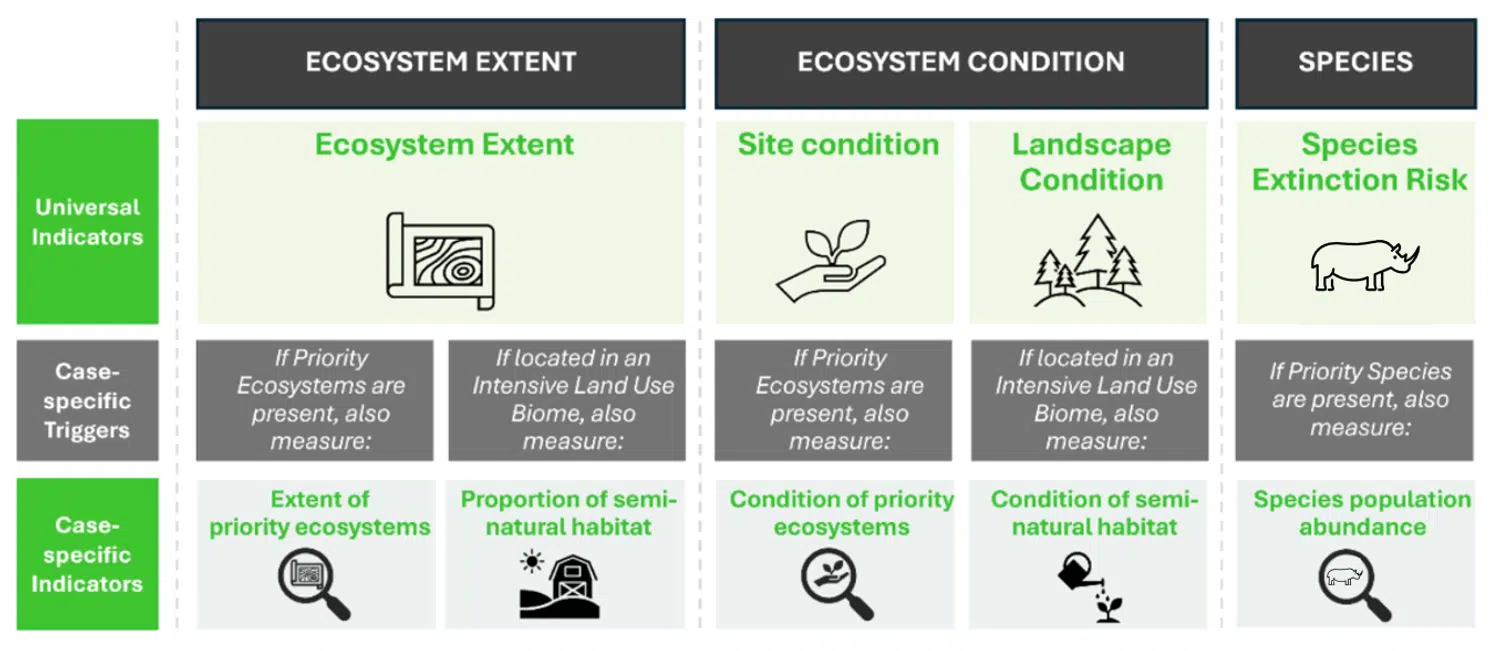
Source: NPI, 2025.[1] These metrics have been subsequently revised following pilot and consultation feedback and applied to the freshwater and marine realms. They will be finalised in 2026, please see www.naturepositive.org/metrics
The pilot program was designed to assess whether a small, aligned set of ecosystem and species indicators could provide a scientifically credible and practically applicable way for companies and financial institutions to measure the state of nature across sectors and geographies. New Forests was selected as one of approximately 30 companies and financial institutions to pilot the draft terrestrial State of Nature Metrics. Insights from participating organisations informed refinement of the metrics prior to a final public consultation held in early 2026. While the finalised metrics are under review,[2] they ultimately aim to support greater harmonisation across emerging frameworks, including nature‑related risk, impact, and disclosure initiatives.
Key Initiative
New Forests participated in the NPI’s State of Nature Metrics pilot program to test whether the metrics could provide a consistent, scalable, and practical framework for assessing the state of nature across a global portfolio of land‑based assets. The pilot program complements and builds on robust asset-level nature-related work already underway, reflecting New Forests’ adoption of the Taskforce for Nature Related Financial Disclosures (TNFD) framework and reinforcing the integration of nature-related considerations across both portfolio and landscape scales. The pilot was conducted across three regions to test applicability across different geographies, land uses, and at multiple scales, including:
- Sub‑Saharan Africa, covering approximately 86,400 hectares of plantation forestry and conservation areas.
- United States (California), focused on approximately 7,600 hectares of semi‑natural forest landscapes.
- Western Australia, encompassing approximately 56,000 hectares of plantation forestry and conservation areas under New Forests’ management in collaboration with other landscape stakeholders.
The pilot engaged two global geospatial providers to calculate the metrics and assess the strengths and limitations of available datasets and methodologies. The analysis relied primarily on satellite‑based data to test whether a lower‑cost, lower‑granularity approach could deliver meaningful insights, supplemented where possible by ground‑based species data such as camera traps, acoustic monitoring, bird surveys, and citizen science observations. The pilot also engaged with a broad range of stakeholders, including internal asset teams, third‑party property managers, NGOs, research institutions, and government bodies. This collaborative approach helped ensure the outputs were relevant at both the portfolio and local landscape scale and useful for real‑world decision‑making.
Impact
The pilot demonstrated that the NPI’s State of Nature Metrics can add value by providing a more consistent, portfolio‑wide view of nature outcomes across diverse land‑based assets. For New Forests, the metrics complement existing on‑the‑ground knowledge and enable more systematic assessment of whether assets are contributing to nature positive outcomes. Additionally, the site condition and landscape metrics show potential to support strategic decision‑making, including, but not limited to:
- Identifying areas of lower ecological condition, where restoration or targeted management may improve outcomes, and higher ecological condition, where restoration or conservation may be expanded.
- Assessing functional connectivity at the landscape scale to inform management actions and collaboration with regional stakeholders.
- Specifically, the site condition metric will be used as the biodiversity impact target for New Forests’ African Forestry Impact Platform (AFIP) portfolio.
The pilot represents a foundational step for New Forests toward integrating scalable and comparable nature metrics into portfolio management and impact reporting. Through an ongoing partnership with NatureHelm, we plan to calculate the metrics across our full global portfolio in FY27, further supporting investor‑grade transparency and decision‑making across diverse assets and geographies.[3]
[1] Available at: https://www.naturepositive.org/app/uploads/2025/02/Draft-State-of-Nature-Metrics-for-Piloting_170125.pdf.
[2] As at May 2026.
[3] For more details, see: https://newforests.com/insight/pioneering-a-global-standard-new-forests-and-naturehelm-deliver-world-leading-nature-positive-initiative-pilot-across-five-countries/.
Delivering on Sustainable Development Goals