" />
" />
Piloting State of Nature Metrics at a Landscape Scale in Western Australia
About
Western Australia’s South Coast is one of the most biodiverse regions on Earth, spanning more than 8.6 million hectares of national parks, conservation areas, plantation forestry, agriculture, and viticulture. It supports numerous endemic and threatened species, but like many mixed-tenure landscapes it faces growing pressure from climate change, land-use change, and habitat fragmentation.
Coordinated conservation action across such a large, multi-tenure landscape depends on having a shared way to measure progress. Despite substantial existing investment in the region, land managers and investors have lacked a consistent, comparable framework for tracking nature outcomes, a gap that has made regional planning and investment in nature-based solutions harder to coordinate, but has also created an opening for new partnerships.
This challenge sits within a broader global shift. As governments and businesses work toward the Global Biodiversity Framework’s goal of halting and reversing nature loss by 2030, the Nature Positive Initiative (NPI) launched a 2025 global pilot to test a draft set of universal terrestrial State of Nature Metrics covering ecosystem extent, ecosystem condition, and species indicators. The aim was to test whether a small, science-based set of indicators could be applied consistently across sectors and geographies, and whether they would be practical for the land managers using them day to day.
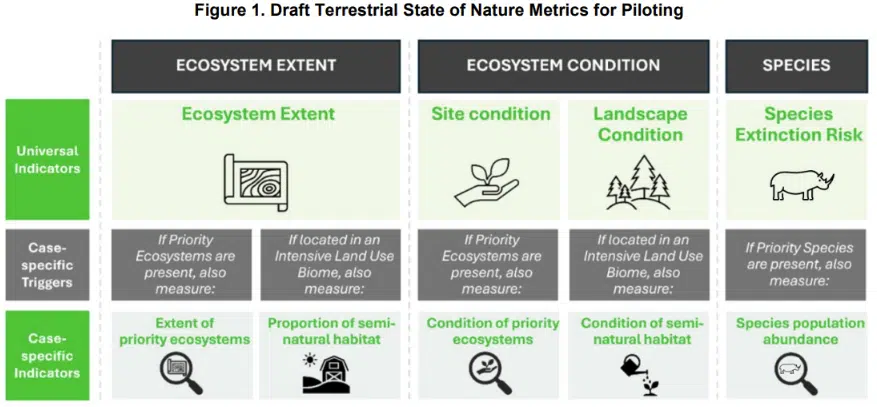
Key Initiative
New Forests partnered with South Coast Natural Resource Management (SCNRM), PF Olsen, and BirdLife Australia to bring the NPI’s draft metrics to life at a landscape scale, the only landscape-level project in the global pilot, offering a distinctive test case for the initiative.
The regional pilot explored whether the metrics could strengthen asset resilience by helping managers identify material nature-related risks and target management action, build investor confidence by testing whether nature outcomes can be measured and reported credibly and comparably, and support SCNRM’s Natural Capital Program with a shared evidence base for prioritising projects and aligning with global nature initiatives.
The analysis spanned multiple scales: 56,000 hectares of forestry, cropping, and conservation land in New Forests’ Forestry Investment Trust portfolio; three SCNRM priority sites ranging from 500,000 to 2.5 million hectares; and the broader 8.6-million-hectare South Coast region. Two global geospatial providers calculated the metrics primarily from satellite-based datasets, testing whether a lower-cost, lower-granularity approach could still deliver meaningful insights, supplemented by local spatial layers and ground-based data including bird surveys. The pilot also included workshops with regional partners, traditional custodians, researchers, government, and industry to share and stress-test the results.
Impact
The pilot showed that the NPI State of Nature Metrics offer a useful starting point for regional conversations about nature condition and connectivity across mixed-tenure landscapes. Satellite-based data at low granularity wasn’t sufficient on its own for detailed regional decision-making, but proved valuable as a screening and hot-spotting tool for identifying areas warranting further investigation, conservation, or restoration.
Beyond screening, the metrics showed potential to support ecosystem condition and connectivity assessments at scale, flag where additional local ecological or ground-based monitoring is needed, give diverse stakeholders a shared framework for discussing the state of nature, and surface data gaps that matter for credible measurement. They are not a substitute for on-ground ecological data, but they can meaningfully enable collaboration and more coordinated investment decisions at a landscape scale.
Conclusion
New Forests, SCNRM, PF Olsen, and BirdLife Australia recommend that other organisations test whether the NPI State of Nature Metrics can inform regional land management, support collaborative regional nature initiatives, and help scale investment into nature positive outcomes. The partners welcome engagement from other groups looking to improve data quality and availability across the South Coast region, a step toward the kind of shared measurement framework the region, and the broader nature positive agenda, will need.
Download the full article here.
Delivering on Sustainable Development Goals